

71% of teachers across Europe say pupils’ attention has declined in just two years – but screen time alone isn’t the problem
- Study of secondary school teachers finds 90% of UK teachers regularly repeat instructions because pupils have lost focus or missed information.
- Three-quarters say attention problems are more likely linked to how devices are used than screen time alone.
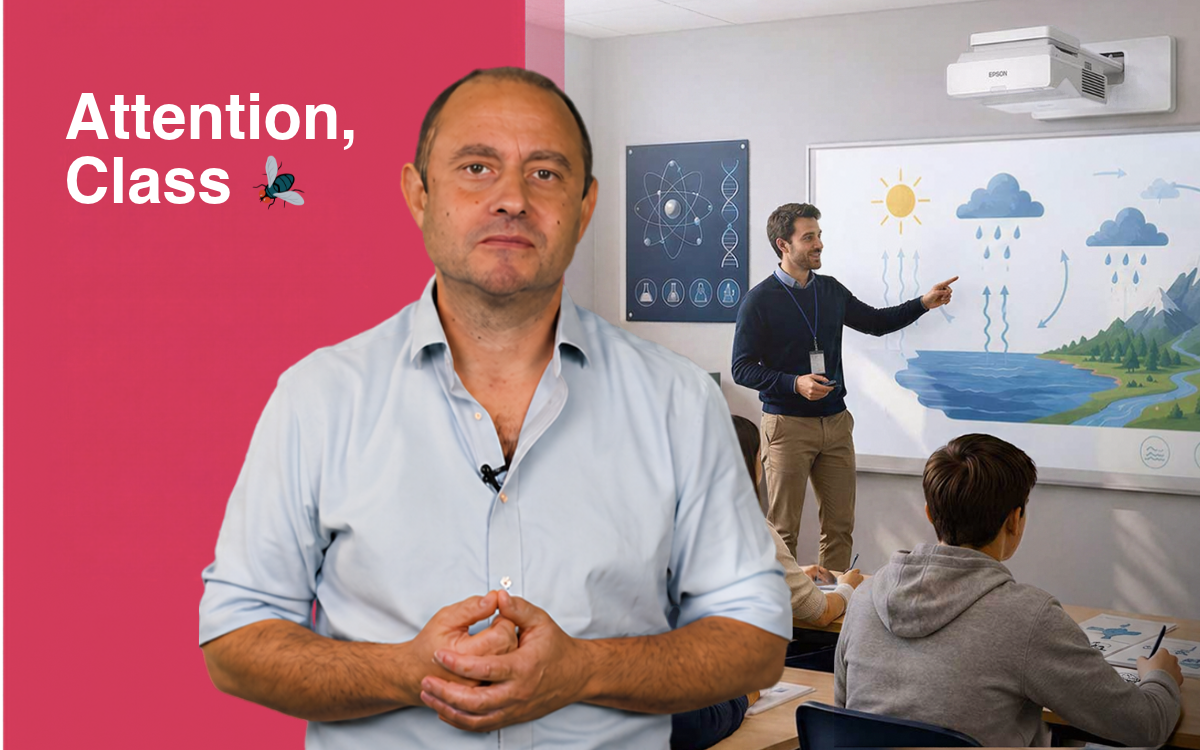
- Epson, European Schoolnet and Professor Sam Wass launch ‘Attention, Class’; a practical and science-backed lesson guide to help teachers strengthen pupils’ attention spans.
Keeping young people focused in a classroom is becoming significantly harder, according to a new European study of teachers.
Research commissioned by Epson across the UK, France, Germany, Italy, Poland and Spain found that three quarters of teachers (71%) across Europe – rising to 75% for the UK alone – say pupils’ ability to focus has declined in the past two years alone.
The impact is being felt throughout the school day. In the UK, nine in ten teachers (90%) say students often need instructions repeated because they have lost focus or missed information, while 87% say pupils frequently lose focus before completing a task.
Teachers estimate 11–18-year-olds stay focused on a single task for around 16 minutes before their attention begins to drop, although this varies across Europe, from 19 minutes in Italy, 16 minutes in the UK and 13 minutes in Poland.
Digital technology is now embedded in classroom learning, with UK teachers estimating that 35% of lesson activities involve individual screens and 54% involve shared screens. However, the findings suggest that technology usage alone is not necessarily to blame for dwindling attention spans.
Three-quarters (74%) believe issues with individual screens are linked to the way devices are used and introduced without adequate training. And three-quarters (73%) of teachers surveyed say staff in their school have not received the training and support needed to get the most from classroom technology.[i]
In response, Epson has partnered with European Schoolnet and neuroscientist, child psychologist and author of Take Action on Distraction, Professor Sam Wass to develop ‘Attention, Class’, a practical, expert-informed lesson and set of classroom resources designed to help young people understand and strengthen their attention.
Rather than removing technology from the classroom, the programme will help teachers and pupils explore what distracts attention, understand the impact of interruptions and task-switching, practise periods of deeper focus, and identify techniques that can help bring attention back when it wanders.
Professor Sam Wass said:
“Attention isn’t simply a countdown clock that runs out after a set number of minutes. How well a young person concentrates can be affected by what they are doing, the environment around them and the way information is presented.
“That means we need to move beyond the idea that screens are inherently ‘good’ or ‘bad’ for attention. Technology can be enormously valuable for learning, but maintaining attention means thinking carefully about how different activities and formats work together – including opportunities to listen, discuss, interact, work independently and focus together as a class.
“Teachers are already doing an extraordinary amount to keep young people engaged in a world in which distractions compete constantly for their attention. What they need are practical, evidence-informed ways to help pupils understand their own attention and learn how to regain it when it drifts.”
‘Attention, Class’ builds on Epson’s wider call for learning environments designed around human attention, engagement and connection, and its research into how different formats – including individual screens, shared classroom displays and analogue materials – relate to attention, absorption and retention. It also answers a need from teachers for more training in using tech in classrooms without causing attention spans to drift. Almost four in five (80%) say they would welcome support designed to strengthen focus, improve learning retention and help pupils build healthier attention habits in a world full of distractions.
Dr. Sarah Henkelmann-Hillebrand, Education Expert at Epson Europe said: “Technology has transformed what is possible in education. However, our research tells us that teachers are dealing with a very real attention challenge. It also tells us they don’t see the answer as simply taking screens away. They want practical support to help them decide when technology adds to a learning moment, when another format may work better and how different approaches can work together.
“A laptop, a piece of paper, a shared display, a discussion and a practical activity can all have a place in a modern classroom. The important question is what will help pupils focus, participate and absorb what they are learning at that particular moment.
“That is the thinking behind Attention, Class. Working with teachers and experts, we want to give schools something genuinely useful: practical ways to help young people understand their attention, strengthen it and use technology more intentionally.”
To explore how the challenge varies across Europe, Epson has also created the European Attention Atlas, based on an Attention Challenge Score combining teachers’ responses to six measures of classroom attention, distraction and retention.
France recorded the highest reported challenges among the six countries studied, followed by Italy and the UK:
Attention Challenge Scores (out of 100)[ii]:
- France: 92.1
- Italy: 89.5
- UK: 87
- Spain: 86.8
- Poland: 82.8
- Germany: 79.1
Attention, Class resources are available to teachers and schools across Europe here
Notes to editors
Research methodology
Focaldata surveyed 3,360 people across the UK, France, Italy, Germany, Spain and Poland on behalf of Epson in July and August 2026, following data quality checks.
The study comprised four discrete audience surveys, fielded independently online via panel: teachers without IT responsibility (1,227), students aged 16-18 (1,219), current or recently qualified teacher trainees (611), and school IT managers/technology decision-makers (303). Results reflect natural fallout, with no weighting applied.
[i] The data featured in this press release is from a subset of 725 teachers of 11 to 18 year olds across Europe – of which 111 are UK based. Aside from the data in the paragraph marked i which is from the full set of 1,227 teachers – of which 215 are UK based.
[ii] The score is based on the percentage of teachers agreeing with each of the below statements and averaging those agreement rates into a score out of 100.
- Students often lose focus before a task is complete
- Students struggle to keep focus throughout the whole lesson
- Students often need instructions repeated because they have lost focus or missed information
- Students often appear to understand something in the moment but struggle to remember it later
- Students find it difficult to stay with longer or more complex tasks
- Students are more easily distracted than previous cohorts I have taught
Related Posts





Share This Story!
